Reverend Strange’s ‘Little Commonwealth’ at Buntingford

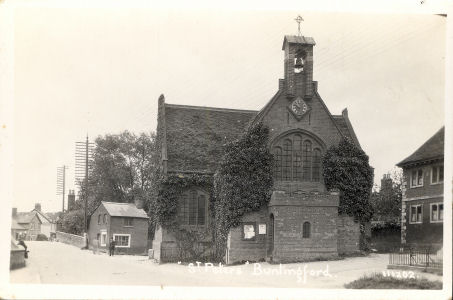
buntingford-st-peter-111202 small

Alexander Strange’s chapel, Buntingford

As Jonson crossed the little bridge into Buntingford on Saturday 11 July 1618 he will have seen a building site on his left. This was to be a small ‘chapel-at-ease’ on which work had begun in 1614, but was not finished until 1628 at a cost of £420. St Peter’s, as it became known, was the great project of Buntingford’s minister, the Rev Alexander Strange, in order to spare the town’s inhabitants the trials of crossing a swollen river to the parish’s main church in Layston. You can still visit it today, though its Victorianisation in 1899 means that it has been altered from the building whose foundations Jonson will have seen. In the western transept, however, there is a plain wood-paneled gallery front from around 1615, and a stone on the east gable bears the inscription DOMUS ORATIONIS 1615.
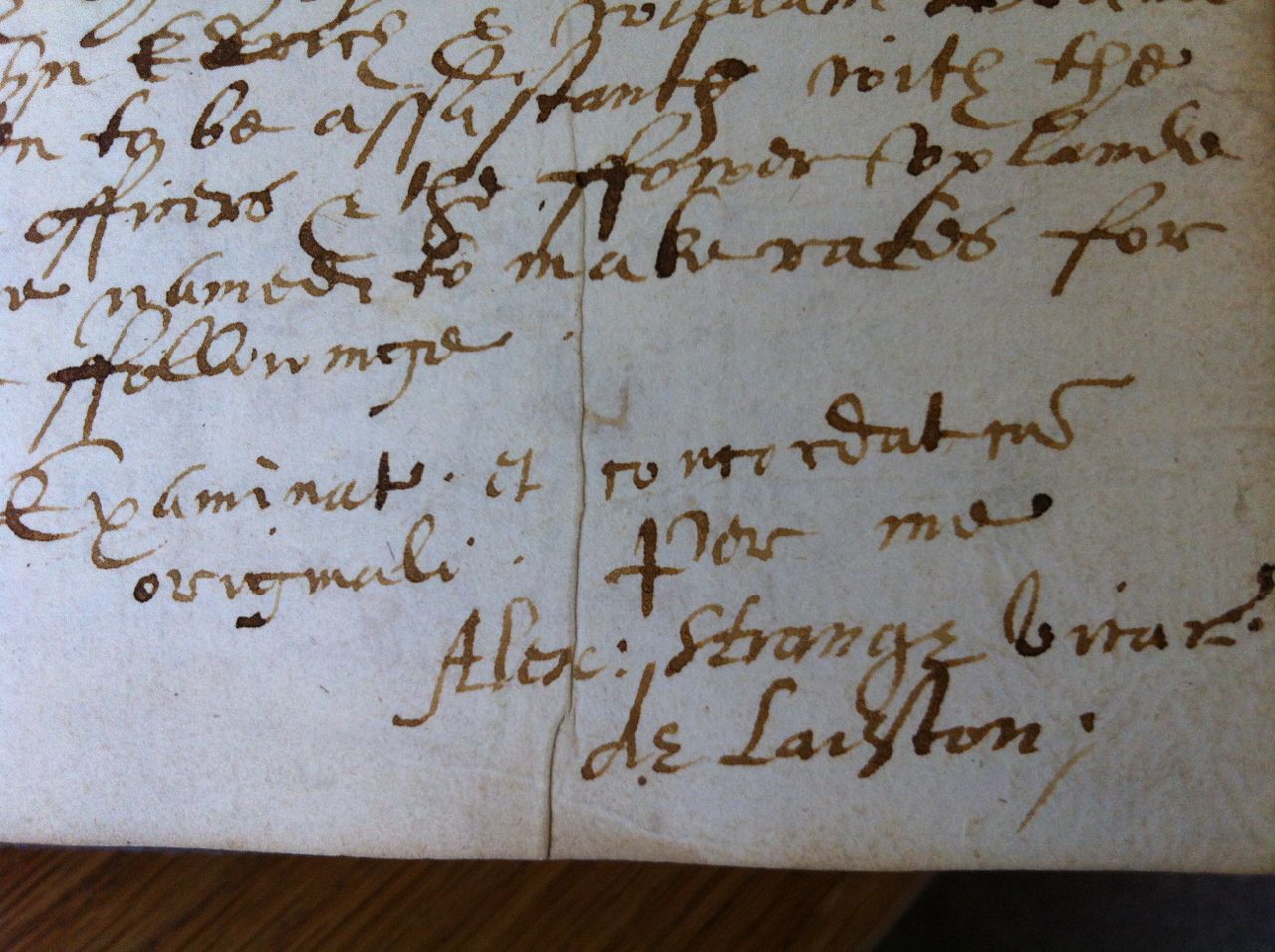
strange

Rev. Strange’s signature in his memorandum book

Inside, a brass plaque of 1620 hangs on the south wall depicting the minister preaching to his congregation in a small Renaissance chapel, thought to represent Strange and his parishioners, on which is inscribed ‘In Stature small, yet great in mental powers,/ Good Alexander built this Church of ours’. Rev. Strange appears to have been a singular fellow, and we are lucky that his memorandum book survives, his distinctive hand recording the parish accounts and administrative decisions, his advice and a tract on poverty. From its pages emerges a deeply conscientious and intensely godly man, whose concern for his parishioners and the poor amongst them results in several schemes to help them.

The first was to ensure their godly souls by erecting this convenient new chapel, and money was set aside for vicars to include thanks in a sermon to those, like Jonson, ‘at whose expense the chappell was built’. Then Rev Strange himself donated several lands whose income was to be used for the poor. He encouraged wealthy Londoners also to make charitable grants, such as one by a goldsmith in 1623 who gave £20 ‘to be ymployed in the buying of flax to sette the poore to work’.

But Buntingford had a problem common to other towns on the main arterial roads in London’s hinterland. A population explosion in southern England had forced many from their villages in search of work. These itinerant families created a pressing problem in towns such as Buntingford, their numbers outstripping the capacity of the rates collected for poor relief. As Rev Strange wrote in his Advice of 1636, ‘I see and am sorry to see the misery into which Buntingford’s residents are fallen …. I will be bold to tell you the Causes of it. Your misery is this, there are come into your parish within the space of these twenty years past, no less than twenty Families, all of which receive’ the parish’s alms. At the same time, the increased pressure on housing led Rev Strange to castigate his parishioners for having fallen victim to ‘the roote of all evill, covetousness’ in their raising of rents.

Jonson and Strange will have had something in common (if not the minister’s more puritan godliness) since Strange had a library filled with classical volumes, including eight volumes of Tulley. At almost the same age (b.c.1570) as Jonson, both had enjoyed an education shaped by classical humanism, its influence plain in Strange’s Advice of 1636 in which he terms Layston and Buntingford a ‘little commonwealth’ where it was every citizen’s duty to play his part.
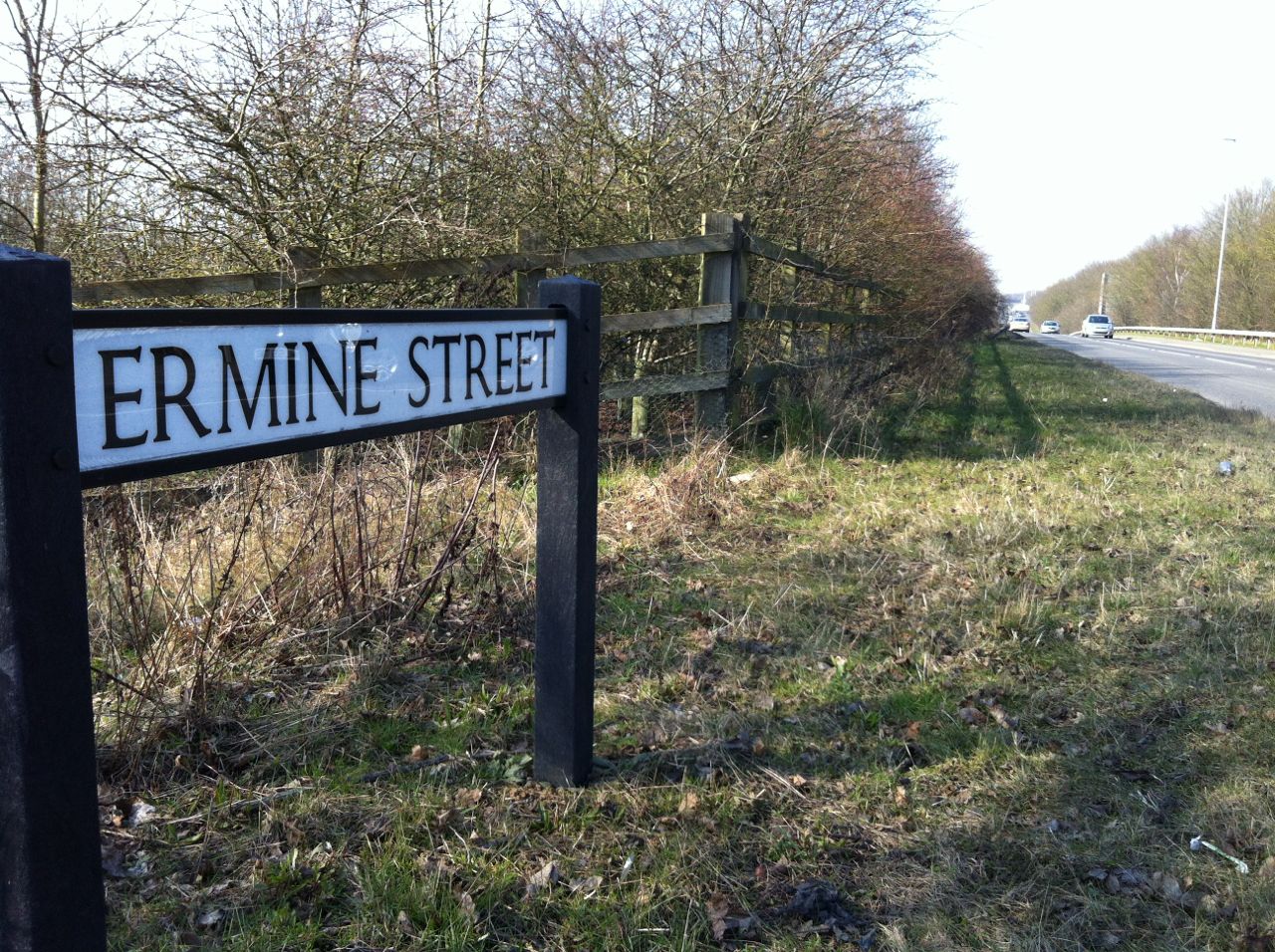
ermine stJonson was to experience a number of these ‘little commonwealths’ as he progressed north, towns in which their civic communities fretted equally about how to look after, and control the poor, at Huntingdon, Stamford, Newark etc. And as he left Buntingford, he walked along the road that joined them, a route still marked by road signs bearing its medieval name of Ermine Street. It’s a remarkably straight route, and one I’ve driven now several times at dusk, imagining Ben’s weary footsteps as he toiled up long slopes towards the light and warmth of a welcoming inn.
A Good Gossip

One of the most striking features of the ‘Foot Voyage’ is the narrator’s consistent use of the phrase ‘my gossip’ to refer to Jonson. This phrase, in fact, occurs 92 times in total – making ‘gossip’ one of the most commonly occurring words in the account. Yet the sense in which it’s used here is unfamiliar to modern readers, so it merits a degree of explanation.

What, or rather who, is a gossip? To us, of course, it means idle talk, tittle tattle, usually concerning other people’s – often supposedly private, at least personal – affairs. Hence, too, it’s a noun for those who engage in such chatter. And it’s not all that respectable: say the phrase ‘gossip columnist’ and the concomitant mental image isn’t usually anything like Woodward and Bernstein.

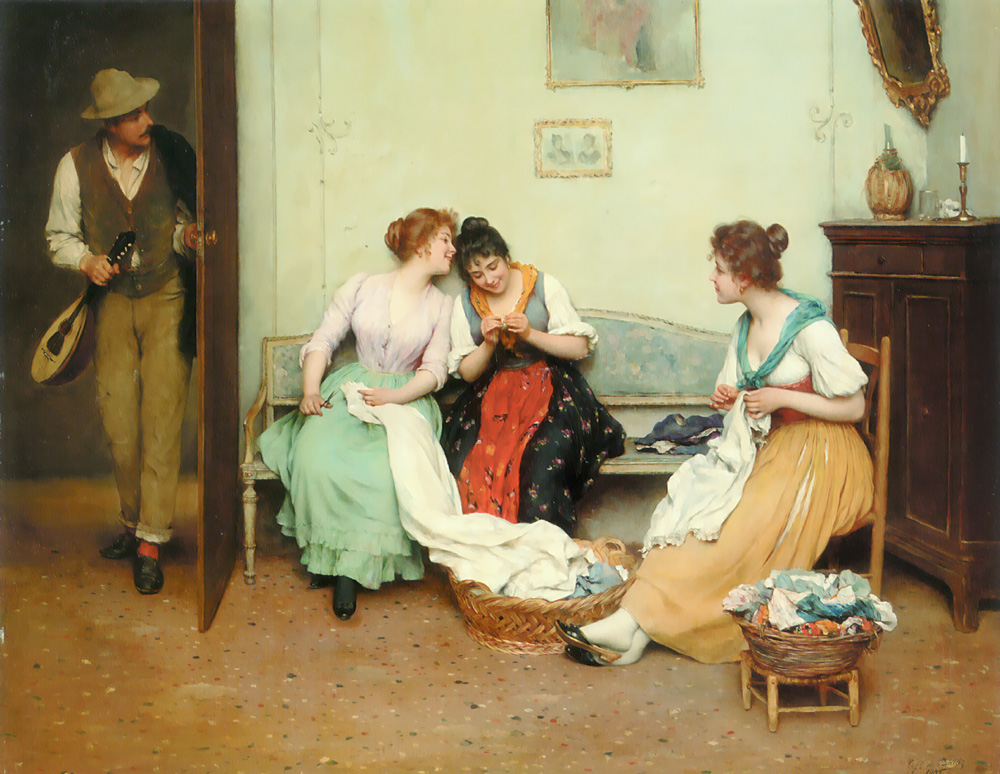
Eugene de Blaas, The Friendly Gossips

Now, this meaning was certainly current in the early seventeenth century – and it usually carried, as it still does now, a distinctly gendered (not to say misogynistic) charge. Gossips were female, and they chattered away incontinently and inconsequentially. They could be played on stage for laughs, as Jonson himself knew: in his play The Staple of News he included a parodic chorus consisting of ‘Gossip Mirth’, ‘Gossip Expectation’, ‘Gossip Censure’ and, unsurprisingly, ‘Gossip Tattle’, ‘gentlewomen lady-like attired‘. Given that this was written for an all-male stage, the resulting impersonations can be seen as the perhaps not too remote ancestors of characters like Monty Python’s head-scarved or pinny-wrapped women, or TV’s very own Cissie and Ada. Of course, we’re past all that now, aren’t we?

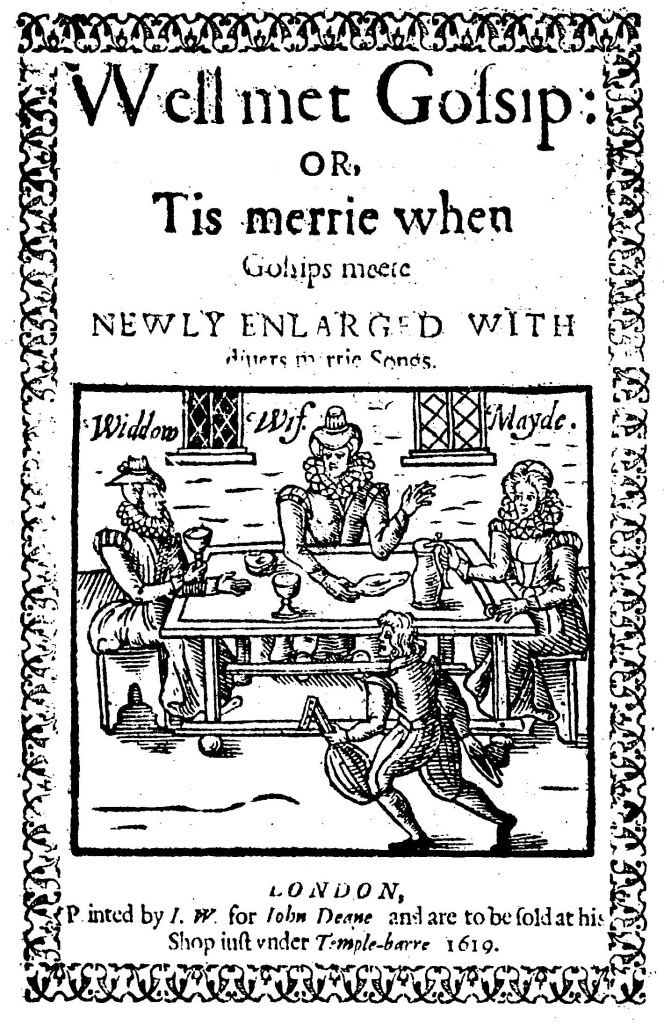
'Tis Merry When Gossips Meet...

‘Tis Merry When Gossips Meet…

Yet just as current was a meaning now entirely lost to us. In The Staple, the gossips take up seats at the edge of the stage, to which they are entitled – they say – as ‘persons of quality‘. (This was one of those strange customs of the early modern indoor stages: some of the most sought after seats in the house were stools on the margins of the playing area. Let’s bring it back at the Sam Wanamaker playhouse.) Yet when the Prologue asks them ‘what will the Noblemen think, or the grave Wits here, to see you seated on the bench thus?‘ Gossip Mirth replies ‘Why, what should they think? But that they had Mothers, as we had, and those Mothers had Gossips (if their children were christened) as we are, and such as had a longing to see Plays, and sit upon them, as we do, and arraign both them, and their Poets.‘ The obvious comedy here is no doubt to be drawn from the gossips’ presumption of both social and critical standing; but what gives it something of an edge is their grounding of their own claims to status in genuinely weighty social roles: motherhood, of course, but also other kinds of kinship, created not by blood but by baptism.

A gossip, etymologically (but also, for Jonson’s era, currently), was a god-sib, a sibling made such by standing as godparent to one’s child. So your gossips would be your children’s godparents, or the parents of those children for whom you were godparent, or those who were godparents to the same child as you – and they could, of course, be both male and female. So while a gaggle of gossips might bring to mind the kind of domestic or familial intimacy that the early modern world usually saw as feminine, gossips could still, in an uncomplicated way, be men.

Complication, though, arises from the fact that the term could be used to mean other kinds of intimacy. Still in relation to spiritual kinship, your gossip could be your own godparent – bringing in a cross-generational aspect that would seem to sit badly with the word’s roots in ‘sib’ or sibling. And it could also be used imprecisely, or figuratively, to mean – as the OED fetchingly puts it – ‘a familiar acquaintance, friend, chum‘. It could be used for erotic, or at least eroticised, bonds: in their correspondence, both King James and his favourite, George Villiers, Duke of Buckingham, addressed each other as ‘gossip’.

So when our narrator calls Ben Jonson his gossip, what does he mean? The short, perhaps disappointing answer is that we can’t tell for sure. What we can say is that he’s laying claim to intimacy: ‘my gossip’, as he says on each of those 92 occasions. Jonson may be the big man (in several senses), the celebrity, the famous and feted author, but to me he’s family. He may be heavy, but he’s also (something like) my brother.

The Outline of a Walk

An initial inspection had provided some clues to the provenance of the Aldersey manuscript – at least, what could be gleaned from looking at how it was put together and the signs of early usage. But that first encounter with the manuscript also raised all sorts of questions relating to the account of the walk itself. Scanning the first page had confirmed, pretty much beyond doubt, that the star of this particular show was indeed Ben Jonson – 8 July, the departure date, was a Wednesday in 1618, just as the opening sentence said, and Lady Mary Wroth would hardly have turned out to greet just anyone along the road at Waltham.

But that confirmation itself brought the slightly stunned realisation that there were bound to be more revelations in the pages that followed. And there were quite a few pages – another 40, in fact. There wasn’t going to be time that day to transcribe it all, so it became a matter of trying to get something like a handle on the scope of the whole thing, rather than focusing on particular details. The fine-grained stuff would have to wait.

So a quick estimate of the word count: those 41 pages contained, it appeared, something like 8,000 words. A pause to take that in. Then, back to scanning the first page to see what could be said, initially at least, about the style and manner of the account. Was this the work of a proto-Boswell, following an earlier larger-than-life Mr Jonson and jotting down his words? Would this give us further glimpses of Ben Jonson’s trenchant opinions on his contemporaries and their writing?

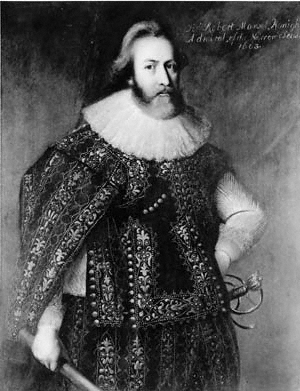
Robert Mansell

Sir Robert Mansell (c.1570-1652), by an unknown artist

Perhaps surprisingly, given Jonson’s reputation for sounding off, it appeared not. The account continued as it began – focused on the itinerary of the journey, and a careful and presumably pretty comprehensive listing of who they met. Proper names – of places and people – began to pile up. Some of them, like Mary Wroth, I knew well. Others rang a muffled bell or two – wasn’t this Robert Mansell, for example, something to do with the Jacobean navy? Others still were utterly unknown to me – they’d need some investigation. But here they all were, attendant on Ben Jonson as he walked his way up the road to Edinburgh.

As I skimmed the pages that followed, I could see that these early emphases were sustained throughout – days on the road passed, and the itinerary grew longer. Moments of colour and detail came into view: something on the weather here, a reference to drink or food or the mood and manner of ‘mine host’ there, over the page an encounter with minstrels or tinkers. Belvoir Castle seemed to flash by; but it looked as if the travellers were spending plenty of time at Welbeck Abbey. In passing, the account described visits to long vanished places such as  the original Worksop Manor and an unslighted Pontefract Castle. There were inns and ordinaries, postmasters’ houses, hospitable widows. And throughout it all the cast list grew longer and even longer. By the time that obviously Scottish names began to dominate, it was clear that there were hundreds of people mentioned here: this was nothing less than a cross-section of society along the road linking King James’s two largest kingdoms.

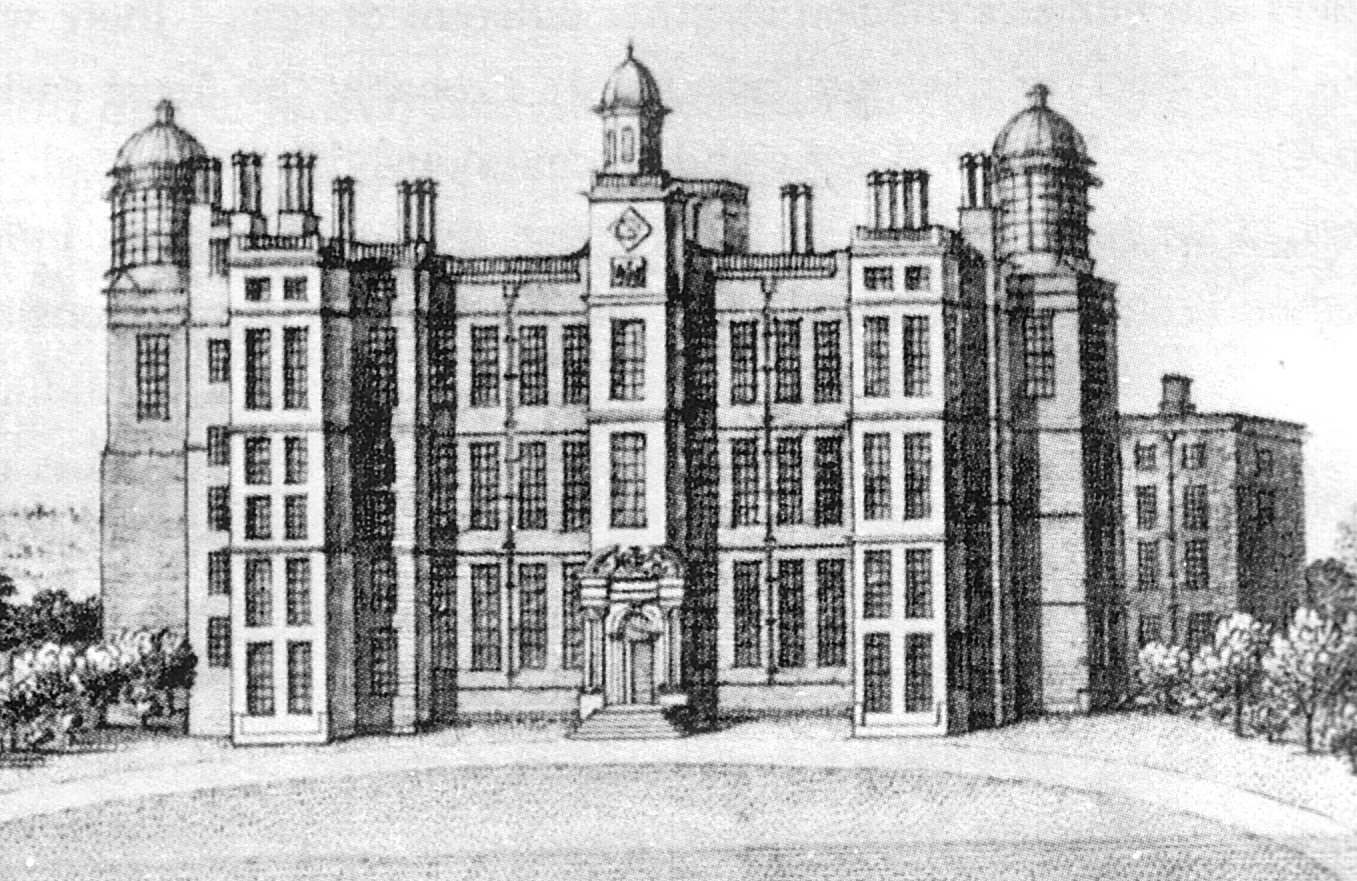
Worksop_Manor

The original 16th century Worksop Manor, burned down in 1761

And then, abruptly, the account came to a halt in a list of Scottish harbour towns. But the writing in this hand continued: some odd bits and pieces, which looked like jests of some sort (Ben was known for his jokes, wasn’t he? Wasn’t there a popular eighteenth century book actually called Ben Johnson’s Jests?).  Some strange details re kidney stones, followed by what looked like historical notes mainly relating to York. And then four pages which were something about ‘Doggs Language’. What on earth..?

This was going to need some sorting out. There would have to be visits to archives and record offices, lengthy enquiry into local, regional and national histories, cross-checking against all of Ben Jonson’s work. There were going to be puzzles and conundrums and unanswerable questions. It was clearly going to take a while. In fact, and so far, four years.

Setting Off

So this is how it begins: ‘Wee set out of London on Wensday the eight of Iuly and reach’d that night to Totnam high crosse, where wee lodgd at the [be] Beare &c. By the way thether wee met with the Shake-ragg errant, and his two doxes etc…’ It took a little while to work some of that out, despite the general clarity and ease of the writing. For a split second, as I began to transcribe ‘Shake-ragg’, there was the terrifying thought that the word was ‘Shakespeare’ – I’m not sure I’d have been up for the sort of hoopla that could have  come with that. Very happy to see it instead shape up into this colourful and obsolete term for, as the OED puts it, a ‘ragged, disreputable person’. And anyway, Shakespeare would have ruled out Jonson – the walk was definitely 1618, some two years after his old friend’s death.

One important question was immediately askable: could this departure from London be dated to 1618? Was July 8 in fact a Wednesday that year? A check established that it was – by the then-current Julian calendar – so that was a step in a good direction. But no guarantee, of course – this could still be some other Johnson entirely, and a different year. Reading on would presumably decide things:

‘From thence to Waltam, where my Lady Wroth came to my Gossip etc…’

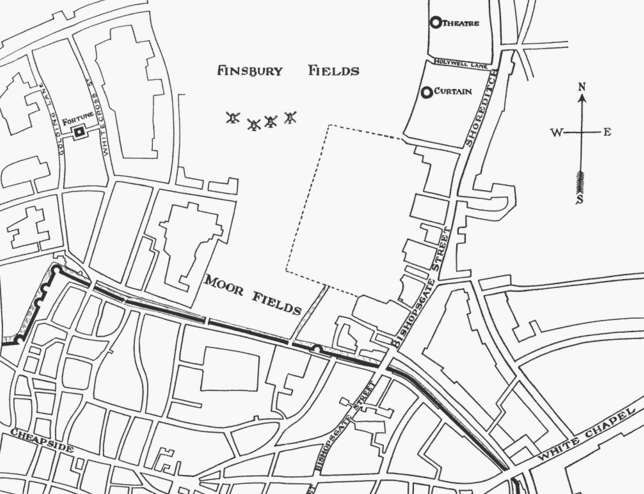
London map showing Shakespearean theatres

London map showing theatres – detail

So from a shake-ragg and his doxies to more elevated company: Lady Mary Wroth, of all people. At that point, conviction grew: given their connection, this really did look like him. This was probably Jonson – this was his walk, datestamped and waymarked. Details lost for centuries began to clarify: if they walked from London to Tottenham, they must have left the city by Bishopsgate and headed up the Old North Road, now the A10; past the still-operating Curtain, and the site of the Theatre – whose timbers became the first Globe – on up to Tottenham.

And then, the next day, straight up the Hertford road to Waltham Cross, past – I was delighted to note, being a Spurs fan of long standing – what was many years later to become White Hart Lane. This was getting better and better!

And then other questions crowded in to trouble the clarity. How interesting, that Lady Wroth should come out from her own house a few miles away to meet him on the road! Was that what had happened? The account didn’t seem to offer any further information. And it didn’t say anything about what passed between them – how she greeted him, how he responded, the tone of their conversation. A mention, and then further names, none of which were anything like as familiar or easily identifiable.

Then a bigger question: who was writing this? Like many others, I’d always imagined a solitary Ben Jonson trudging up the country – there was no evidence to suggest otherwise, though when the royal waterman and poet John Taylor went on his ‘penniless pilgrimage’ to Scotland that same summer he had a horse and servant with him. In his 1973 play Bingo, Edward Bond had Jonson say to Shakespeare, in 1616: ‘I’m off to Scotland soon. Walking. Alone. Well, no one would come with me’. Only someone did. But who?