About Anna Groundwater

Anna Groundwater is the post-doctoral research fellow on the project at the University of Edinburgh, where she also lectures in early modern British and Scottish history.

Rufford Abbey: a House’s Changing Character

When Jonson crossed the threshold of Rufford Abbey, he was entering into the complicated world of no fewer than two countesses of Shrewsbury and the Welbeck Cavendishes (of whom more to come soon). His connection with this extended family and their households was to be a substantial help to him as he travelled through Nottinghamshire, the West Riding of Yorkshire, and Northumberland.

Rufford Abbey, image thanks to English Heritage @EnglishHeritage

Rufford was a former Cistercian monastery, a substantial estate lying just within the north-eastern boundary of Sherwood Forest. It was a place renowned as a hotbed of recusancy – that is, lingering Catholicism. Its occupants until 1616 had been Gilbert and Mary Talbot, the 7th earl and countess of Shrewsbury. Gilbert had come to a relatively unhappy end for an earl, dying impoverished in 1616, and Lady Mary (a Cavendish by birth) in July 1618 was languishing in the Tower of London for the second time, for her refusal to divulge what she knew of her cousin Lady Arabella Stewart’s marriage and alleged pregnancy. She was eventually fined £20,000 for her obdurate silence. On the occasion of her first imprisonment in 1611, the rival local magnate Sir John Holles was sent to search Rufford, and he penned his disapproval of the trappings of catholicism that he found hidden, the ‘books, beads, crosses and pictures’ in the granges behind the abbey:

the house, a confused labyrinth, underneath all vaults; above, entries, closets, oratories, many stairs down and up, trap doors to issue forth and trap doors to lead into garrets, so as in my search I was never so puzzled in my life’… ‘trapdoors to conceal and issue forth such pernicious vermin as I sought for … I heard presently, these fellows [hidden papists] dislodged and all stuff that was either of weight or superstition conveyed away by coach and cart.

Rufford, he said, backed onto

a great woodland country fraught with many scattered granges and all of these inhabited with obstinate recusants, fled to that asylum from Derbyshire, Yorkshire, Lincolnshire etc, as in a covert, by many back and trap doors, so as, if the forest way may be called via regia, this woodland way is really via pontificia, and altogether environed with the Countess’s dependency.
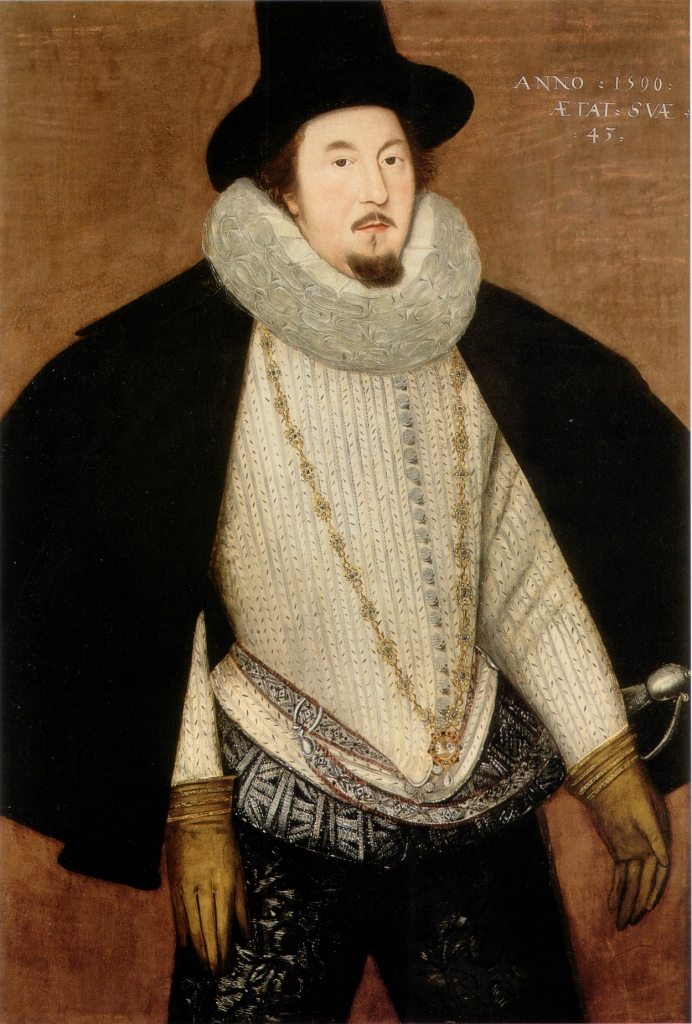
Gilbert_Talbot_7th_Earl_of_Shrewsbury_1596_2

Gilbert Talbot, 7th Earl of Shrewbury, in 1596

When Gilbert Talbot died, Mary Talbot’s replacement as countess was Jane, wife of Edward Talbot, the 8th earl of Shrewsbury, who had only lived for two years to enjoy his powerful title. As the eldest daughter and heiress of Cuthbert, 7th Baron Ogle of Northumberland, Jane was not as financially embarrassed as her predecessor. She was also the sister of Lady Katherine Cavendish, the recent widow of Sir Charles Cavendish who had so ably diverted much of Gilbert Talbot, the 7th earl’s possessions in his own direction. (Are you keeping up?) So they were a very interwoven bunch, the Shrewsbury estate being keenly contested by the husbands of Gilbert’s daughters, against Jane’s nephew, Sir William Cavendish of Welbeck, executor and beneficiary of Gilbert’s will. In 1618, in a separate case, Jane’s very ownership of Rufford was being contested by another impoverished Talbot lady, Grace, and it eventually descended after Jane’s death to the Savile family of Yorkshire.

In the meantime, and despite all the legal wrangling, Jane Shrewsbury ran the household at Rufford. She was not suspected of recusancy, and in her time the Abbey was known not for religious subterfuge or conspiracy but, instead, for its free hospitality. The poet and doctor Richard Andrews, a connection of the Cavendish family, praised her generous provision of ‘Almes’ in a poem of the 1620s, and the (very) minor writer William Sampson echoed this praise of the charity and hospitality, ‘which she at Rufford every day did show’. Jonson, a beneficiary of some of this liberal entertainment, was himself to write an epitaph for Jane (Underwood, 28) on her death in 1625:

A noble Countesse, grave,
In blood, in birth, by match, and by her seate;
Religious, wise, chast, loving, gratious, good,
And number Attributes vnto a flood.

She was interred in an impressive tomb in Westminster Abbey alongside her husband.

Rufford and its park also provided good hunting, Jonson being taken to hunt for gamebirds, and the countess frequently entertained King James on his hunting expeditions. One such was described by Sir Thomas Wentworth, later earl of Strafford in 1624…

I write you news from the Court at Rufford, when the loss of a stag and the hounds hunting foxes instead of deer put the king into a marvelous chafe … In the height whereof comes a clown galloping in, & staring full in his face: his blood (quoth he), Am I come forty miles to see a fellow? And presently in a great rage turns about his horse, and away he goes faster then he came. The oddness whereof caused his Majesty and all the company to burst out into a vehement laughter, and so the same for that time was happily dispersed.

You can visit Rufford today, now under the stewardship of English Heritage and Nottinghamshire County Council. From its walls and walks you can perhaps still get a sense of these contrasting moments in its history, and the personalities of the inhabitants who gave it its life.
A Belvoir Blank

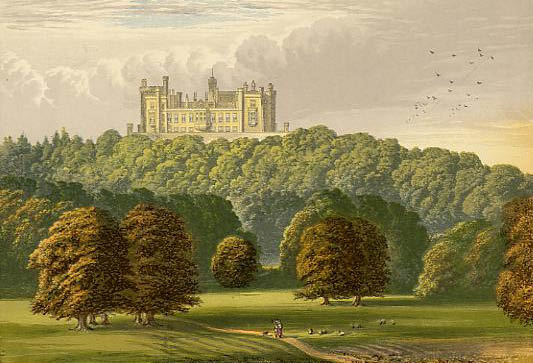
As Ben Jonson approached Belvoir castle from the east, he will have seen it from some distance, standing proud on its rock overlooking the Vale of Belvoir; in fact, pretty much the same effect as you get today as you drive along the A607. A ‘Pindaric Ode upon Belvoir Castle’ of 1679 thus describes,

Belvoir, Art’s master-piece, and Nature’s pride,
High in the regions of etherial air,
Above the troubled atmosphere…
See with what comely state
It unconcern’d o’erlooks the humble plains,
And, from its eminence, commands
The fruitful vale, and far out-stretched lands.

Belvoir in its nineteenth century incarnation, the castle Jonson stayed in having burnt down

And as Jonson climbed the 200 steps up the hill to the castle, he will have been able to look out over the Vale, to see the spires of Lincoln Cathedral on its own mound and those of the myriad of warm sandstone churches in between, a ‘most delicious and pleasing prospect, being accounted one of the best prospects in the land’. Leland described the Vale ‘barren of wood [but] very large and very plentiful of good corn and grasses’. The spires will have included that of Bottesford where still lie the ancestors of Jonson’s host that day, the earl of Rutland (more on this in the next blogpost).

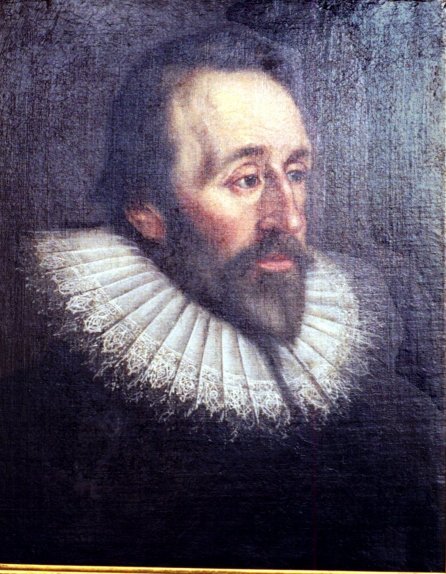
Francis Manners, 6th Earl of Rutland

Francis, 6th earl of Rutland, had inherited the title from his lively brother Roger in 1612. The family had close connections with the court, and the literary world: Roger’s wife had been Elizabeth, daughter of the famed Elizabethan poet, Sir Philip Sidney. She had been one of Jonson’s patrons, the addressee of several of his poems, and had also performed in court masques. Jonson described her to Drummond of Hawthornden as ‘nothing inferior to her father [Philip Sidney] in poesy’. Sadly for Jonson, she too died prematurely a fortnight after her husband in 1612. The new earl’s countess was Cicely Hungerford, a known recusant, and Francis had also embraced Catholicism, which added a frisson of danger to their household in a militantly Protestant period. But despite this Francis was a trusted advisor to the king. He was also a patron of the arts, commissioning an impresa from William Shakespeare and Richard Burbage in 1613 for that year’s accession day tilt, and took part in a couple of Jonson’s court masques.

Theirs was a busy and numerous household as befitted their noble status, and lofty surroundings. The Rutlands’ accounts portray a rich picture of generous hospitality, and varied entertainment, and a vivid example of what was expected of a noble establishment in Jacobean England. That summer, for instance, ‘one rundlet of muscadell’, a cask of 17 gallons of sweet white wine, was sent to Belvoir, so Jonson will have drunk well. Jonson meets Andrew Marks, a gentleman of the household, its music master, and lutenist, and Captain Stratford, a veteran of the Low Countries military campaigns, the earl’s general factotum. The Rutlands, like other nobles, had a private chaplain too, reputedly a Catholic, though they also had close ties to the very Protestant vicar of Bottesford whom Jonson was to meet a couple of days later.

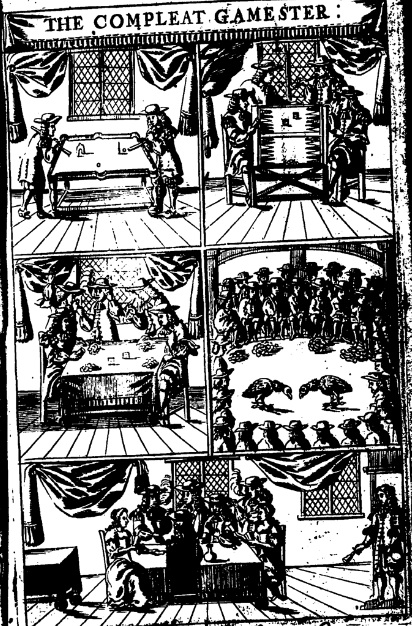
Charles Cotton, The Compleat Gamester, or, Instructions how to play at billiards, trucks, bowls, and chess, 1674

The earl spent a fortune on silverware and goldware for gifts and important occasions, hiring extra gilt bowls for royal visits, with neighbouring nobles lending hangings and furnishings for such occasions. Several payments were made for travelling musicians to play for the household, in addition to its own musicians. The Rutlands’ involvement at court necessitated appropriate clothing, in 1616 a goldsmith being paid £30 for 25 yards of silver velvet; 2 yards of crimson mantua velvet cost £10 a few years later. The countess had received a gold chain set with 138 small diamonds costing £251 in 1613, and the earl’s chains for Garter ceremonies had diamonds added to them. Francis Rutland liked to gamble too, while bowling ‘at the Greene’ with the king, or playing chess or ‘pennie pricke’, a betting game of throwing something at a coin as target, or gleek, a card game. In 1615, 20 shillings were delivered to the earl whilst playing pennyprick with Captain Stratford and other gentlemen in the Great Chamber at Garradon.

In temporary residence that July at Belvoir, was Robert Bertie, Lord Willoughby, Francis Rutland’s close friend, colleague in the drainage of Lincolnshire fens, and his regular hunting companion. This last was probably why Willoughby was there that week, for it was ‘venison season’ which according to Aubrey’s Brief Lives was the months of July and August, the traditional months too of King James’s summer progresses, as he hunted his way around the shires. Rutland’s accounts show he was a keen huntsman, of deer, foxes and hares, as well as enjoying hawking for pheasants, and he was also careful to preserve the hunting in his region for the king, in 1619 appointing gamekeepers to look after the game there ‘for the King’s sport’. Jonson was to see this earl hunting, as he was to see several other instances of this pastime, benefitting indeed from it in the sides of venison that he to receive…

Belvoir remains the home of the earls of Rutland, though much of the castle that Jonson will have stayed in has long disappeared, damaged in the Civil Wars and a nineteenth century fire. What’s more, the account is sadly silent on the nature and extent of his entertainment here – Jonson’s companion was ill, it seems, and not party to whatever transpired. In the light of the very full household records preserved in the Rutland manuscripts, we can conjecture: but in this instance, the ‘Foot Voyage’ itself doesn’t fill in the blanks.

No ‘Ordinary’ House: Inns, Alehouses and Taverns

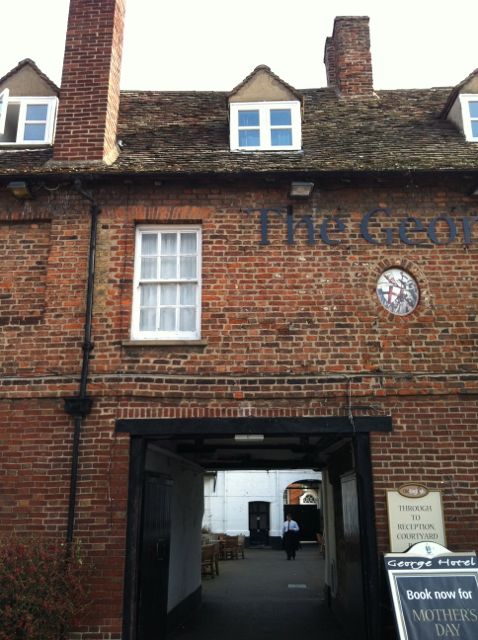
As Jonson ‘came weary to bed’ at Huntingdon on the night of Wednesday 15 July he will have been glad to find this red-brick hostelry which still operates as an inn today, positioned on the old burgh’s limits. In 1598, The George was owned by Sir Henry Cromwell of Hinchingbrooke, of a local gentry family, and grandfather to the future Lord Protector, Oliver Cromwell. It is possible that by 1618, The George was in the hands of the family of Oliver’s father, Robert, who had inherited property in Huntingdon from Sir Henry.

george

The George, Huntingdon

Huntingdon was then a busy market town given its position on the Great North Road. The George was one of several such inns servicing the travellers, traders, and dignitaries that passed through, though it was probably grander than most of the others – The Bull, The Cock and Hoop, and The Swan on Temple Lane, and The Falcon on St Mary’s Lane amongst others. In 1598, Sir Henry Cromwell had paid 11s 11d rates on it to the borough, considerably more than the 3 pennies paid by the owner of The Falcon.

Inns were the nexus points in a network of roads that linked towns in the regions to each other, and to London. They provided lodgings and sustenance for travellers, the place in which to entertain visiting grandees, local JPs often met there to hold their assizes, and horses were replenished. Although no mention is made of any accompanying horse, Jonson will presumably have had one to carry his bags. In addition, one innkeeper in each of the larger towns on the Great North Road will have also acted as postmaster, the inn providing a staging post for the carriers of the royal mail.

Innkeepers thus became important figures in any journey, and travellers’ tales often recount the quality of their entertainment. John Taylor, the water-poet travelling to Scotland the same summer of 1618, thought innkeepers should be ‘the Mirror of Goodfellowship, the Pattern of true Friendship, and the nonparallel of jovial Entertainment’. At Huntingdon he had stayed at The Crown, the postmaster’s inn. His host being

Informed who I was, and wherefore I undertook this my pennilesse Progress, came up into our chamber, and supped with us, and very bountifully called for three quarts of Wine and Sugar, and four Jugges of Beer. He did drink and begin Healths like a Horse-leech, and swallowed downe his cuppes without feeling. In a word, as he is a Poste, he drank poste, striving by all means to make the Reckoning great…

which he left to a disgruntled Taylor.

Jonson was to stay in such inns when on the Great North Road, but appears to have had a happier experience than Taylor in most, except one hostelry at Chester-le-Street where ‘mine host was a drunken, disordered fellow’. Some, like the Nag’s Head on Sandhill in Newcastle, and The George, ‘the famous ordinary’, in York’s Coney Street have gone. But several of them, such as The Falcon in Puckeridge as well as The George at Huntingdon, retain their original operations today. Some erstwhile inns have been converted to other purposes – the oldest part of the White Hart at Newark, for example (of which more in a later blog post) is now the office of a building society.

white hart

The White Hart, Newark

Jonson will have stayed overnight in inns, but there were other grades of hostelry where he could expect different fare. An ‘ordinary’ was any type of establishment where a meal could be had at a fixed price, the more elevated of these turning into gambling clubs for the urban elites in the later part of the seventeenth century. Innkeepers usually had wine licences, their annual dues helpfully (for us) recorded in the Exchequer Accounts at the National Archives in Kew. Thomas Kay’s at York was a pricey £4 10 shillings pa, whilst only £2 was due from William Carver who hosted Jonson, and judges on their circuits, at Doncaster (Carver soon made his money back, one judges’ bill coming to over £11). A step down was to the more prolific alehouses, where Jonson and his companion will have slaked their thirsts in the heat of the day, drinking small beer or ale rather than the heavier canaries and hullocks of the finer inns.

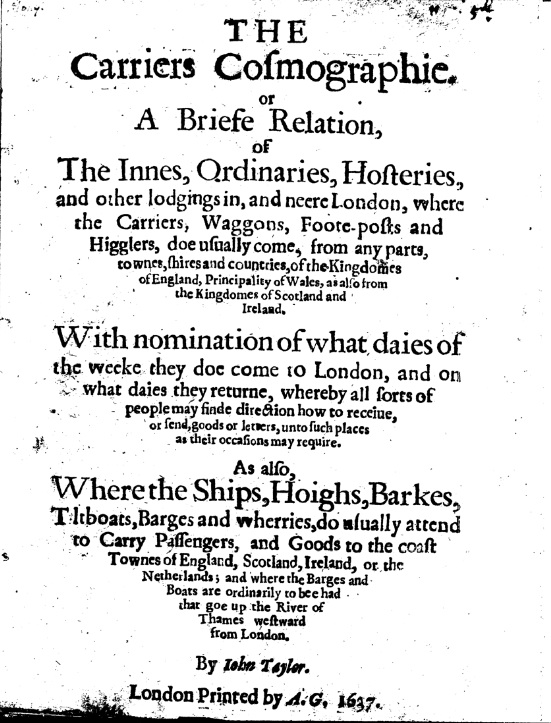
Taylor CosmographieBut the prevalence of alcohol and ‘mine hosts’ throughout our journal attests to the centrality of such establishments in seventeenth century life. In the absence of a sufficient town hall, the better sorts of inns became a central meeting place of the civic elites. Borough accounts throughout England include payments, such as at Doncaster in 1618 for the five shillings and 10 pence to an innkeeper ‘for a gallon of Claret a pottle of sack a pottle of white wine for my Lords grace of yorke & a quart of Claret & sugar for Mr Maior’. Jonson, the frequenter of the Mermaid and other such London taverns, was to indulge liberally in the liquid fare of their country cousins.

Reverend Strange’s ‘Little Commonwealth’ at Buntingford

buntingford-st-peter-111202 small

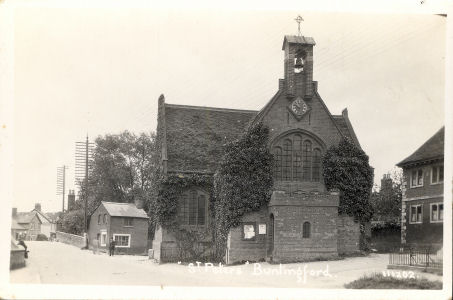
Alexander Strange’s chapel, Buntingford

As Jonson crossed the little bridge into Buntingford on Saturday 11 July 1618 he will have seen a building site on his left. This was to be a small ‘chapel-at-ease’ on which work had begun in 1614, but was not finished until 1628 at a cost of £420. St Peter’s, as it became known, was the great project of Buntingford’s minister, the Rev Alexander Strange, in order to spare the town’s inhabitants the trials of crossing a swollen river to the parish’s main church in Layston. You can still visit it today, though its Victorianisation in 1899 means that it has been altered from the building whose foundations Jonson will have seen. In the western transept, however, there is a plain wood-paneled gallery front from around 1615, and a stone on the east gable bears the inscription DOMUS ORATIONIS 1615.

strange

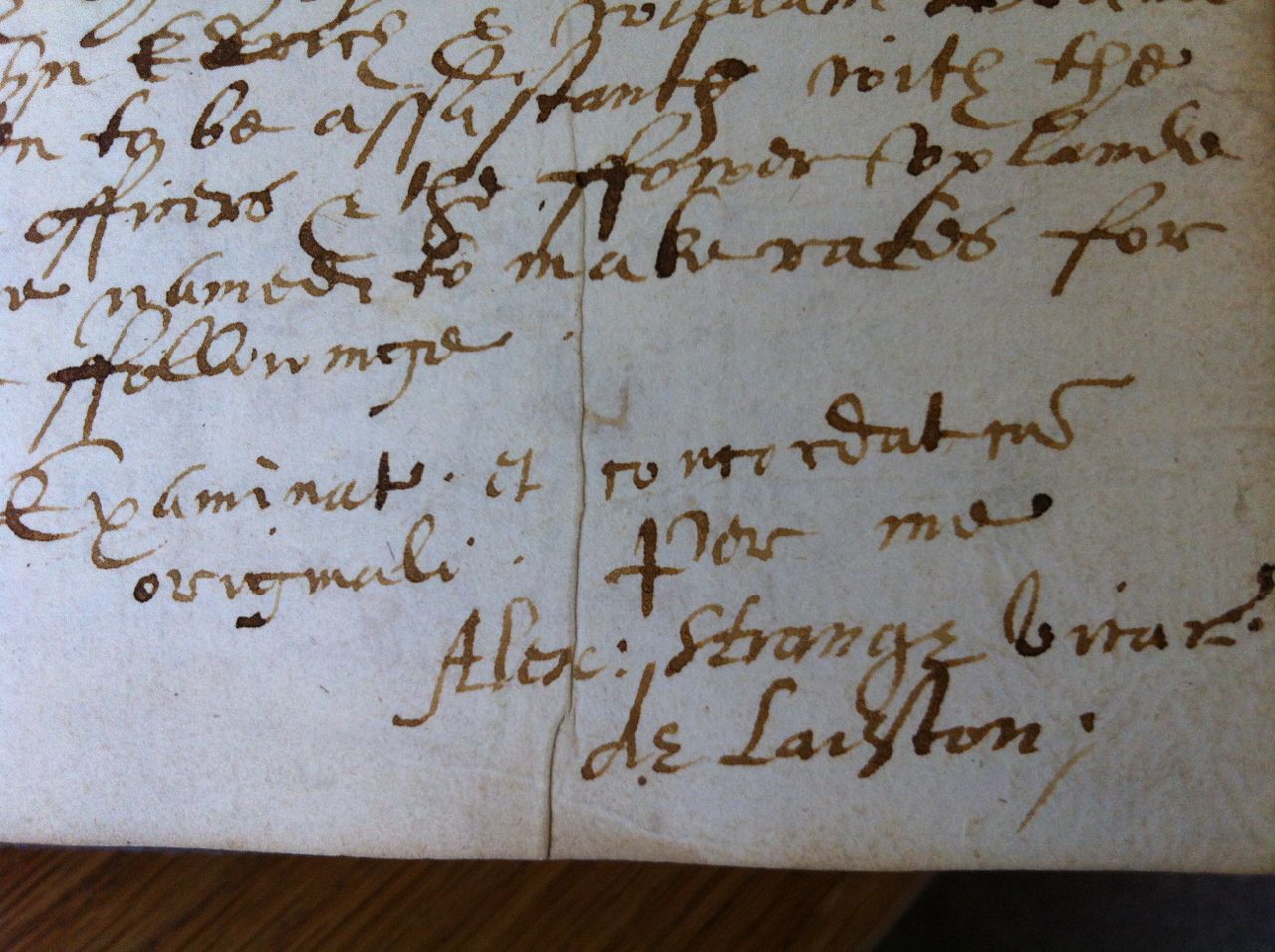
Rev. Strange’s signature in his memorandum book

Inside, a brass plaque of 1620 hangs on the south wall depicting the minister preaching to his congregation in a small Renaissance chapel, thought to represent Strange and his parishioners, on which is inscribed ‘In Stature small, yet great in mental powers,/ Good Alexander built this Church of ours’. Rev. Strange appears to have been a singular fellow, and we are lucky that his memorandum book survives, his distinctive hand recording the parish accounts and administrative decisions, his advice and a tract on poverty. From its pages emerges a deeply conscientious and intensely godly man, whose concern for his parishioners and the poor amongst them results in several schemes to help them.

The first was to ensure their godly souls by erecting this convenient new chapel, and money was set aside for vicars to include thanks in a sermon to those, like Jonson, ‘at whose expense the chappell was built’. Then Rev Strange himself donated several lands whose income was to be used for the poor. He encouraged wealthy Londoners also to make charitable grants, such as one by a goldsmith in 1623 who gave £20 ‘to be ymployed in the buying of flax to sette the poore to work’.

But Buntingford had a problem common to other towns on the main arterial roads in London’s hinterland. A population explosion in southern England had forced many from their villages in search of work. These itinerant families created a pressing problem in towns such as Buntingford, their numbers outstripping the capacity of the rates collected for poor relief. As Rev Strange wrote in his Advice of 1636, ‘I see and am sorry to see the misery into which Buntingford’s residents are fallen …. I will be bold to tell you the Causes of it. Your misery is this, there are come into your parish within the space of these twenty years past, no less than twenty Families, all of which receive’ the parish’s alms. At the same time, the increased pressure on housing led Rev Strange to castigate his parishioners for having fallen victim to ‘the roote of all evill, covetousness’ in their raising of rents.

Jonson and Strange will have had something in common (if not the minister’s more puritan godliness) since Strange had a library filled with classical volumes, including eight volumes of Tulley. At almost the same age (b.c.1570) as Jonson, both had enjoyed an education shaped by classical humanism, its influence plain in Strange’s Advice of 1636 in which he terms Layston and Buntingford a ‘little commonwealth’ where it was every citizen’s duty to play his part.

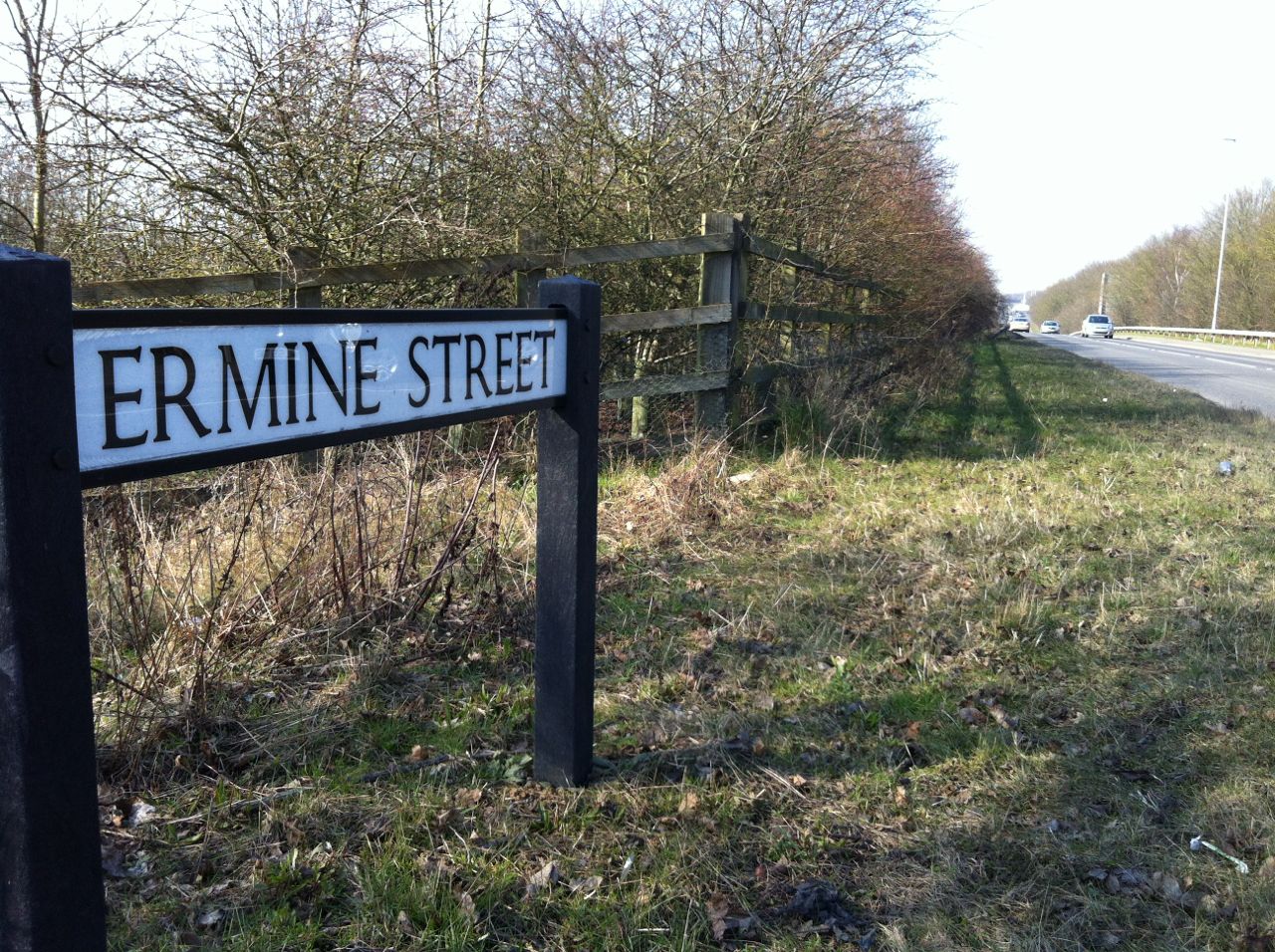
ermine stJonson was to experience a number of these ‘little commonwealths’ as he progressed north, towns in which their civic communities fretted equally about how to look after, and control the poor, at Huntingdon, Stamford, Newark etc. And as he left Buntingford, he walked along the road that joined them, a route still marked by road signs bearing its medieval name of Ermine Street. It’s a remarkably straight route, and one I’ve driven now several times at dusk, imagining Ben’s weary footsteps as he toiled up long slopes towards the light and warmth of a welcoming inn.