When the show was over.

When the show was over.
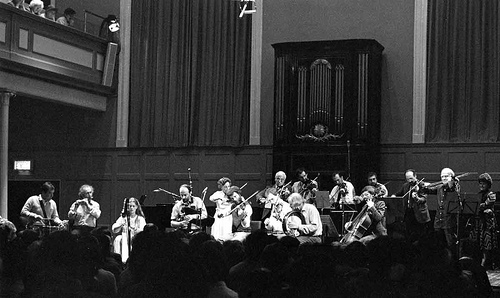
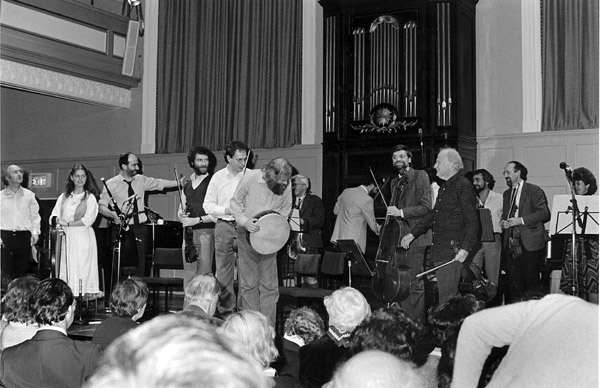
Well, here is an interesting photograph, by Antonia Reeve, of an event at the Edinburgh International Festival in 1985 that brought together a range of Scottish fiddlers with Yehudi Menuhin and my own group the Whistlebinkies. That’s me in the light shirt seated in the middle. Ron Gonnella is over my shoulder.
Reviewing the concert in the New Statesman on 25 August 1985 Angus Calder wrote:
[Hugh] MacDairmid wished Scottish culture to live in a modern and international ambiance. One afternoon at Queen’s Hall, Yehudi Menuhin met the Whistlebinkies, a folk band, and six fiddlers expert in different styles. Mr Menuhin’s Delight triumphed because it was so nearly a cockup. Audience and performers were delighted by a common fear of disaster. The Beeb [BBC], recording the event, had failed to provide technology to ensure that Menuhin’s conversations about technique with other artists could be heard in all sections. The compere kept fluffing and some of the fiddlers looked frightened by the occasion. But they played gloriously. Ron Gonella’s suavely beautiful tone contrasted with Bob Hopkirk’s bagpipe-influenced style and the great Aly Bain’s fierce Norse-Shetland virtuosity. The occasion became historic when Edna Arthur played with supreme skill and intensity a magnificent pibroch dating back to 1526, transcribed for the fiddle in the late 18th century.
Whistlebinkies’ flautist. Eddie McGuire, is also Scotland’s leading avant-garde composer (and left-wing with it). The final item was a new slow air and reel written by him for Sir Yehudi. All the performers assembled to participate. The great man, due to lead off, fluffed on the first note, said sorry, and lunged on at once like a small child performing at its first school concert. The piece was fine, the applause was tumultuous; Menuhin played much better in the encore. I felt I was hearing the feudal past being ferried across to the socialist future. Elated, I went out into another torrential downpour. God really doesn’t like to see Scotland getting too big for its boots – or, rather, growing into bigger ones.
I’m sure there is a sound recording of the day out there and I’m on its trail. I have the original programme note somewhere which I will post here. I’ll also capture some others’ memories of the day.
I’ve added a new page Old Rosin to the blog which is currently made up from posts from an older blog of mine on non-revival related fiddle thoughts and ramblings. I will add to this over time and announce any new entries here.


In our discussion on Ron Gonnella the other day, Jane MacMorran mused over whether Ron had been a musical friend of the accordionist Jimmy Shand. Jane had heard that as a child Ron would climb on stage at local dances where Shand was performing and play along on his fiddle. I promised to look at David Phillip’s biography of Jimmy to see if there is any reference to this. Imagine my surprise and delight when I opened by copy of the book purchased in an Edinburgh second-hand shop some years ago. I had forgotten that I had bought Ron’s personal copy, signed and dated (August 1976), which had been presented to him by Jimmy Shand! It carries the dedication: To Ron, Happy to Meet, Sorry to Part, Happy to Meet Again, Jimmy Shand.

I stumbled upon this old newspaper photograph from around 1970 (or just before?) of a charity music night at the Royal Edinburgh Hospital. You can see Mike Whellans and Aly Bain (fiddle), Doli MacLennan (Gaelic singer)… but I wonder who the Northumbrian Pipes player is. Anyone know?

Today I had a delightful visit and long conversation sharing information, archival material and memories of the fiddler Ron Gonnella with Jane MacMorran, Director of the Appalachian, Scottish, and Irish Studies Program and Lecturer at East Tennessee State University.
Ron was famous for his polished, smooth performance of slow airs and lively jig playing which made him a favourite of the BBC and record companies. His musical and life styles were quite far removed from those of the fiddlers of the folk revival, and it might be suggested that, within the world of Scottish fiddle, his was the model that many revival players consciously sought NOT to emulate. What he did offer to all players in Scotland and abroad was awareness of the old repertory buried in the great collections and rehabilitation of the great legacy of Scottish jig (3/4) tunes through his books, broadcasts and records. In this way he was a good example of the ‘tradition barer’ (as opposed to the ‘tradition bearer’) I have discussed elsewhere. His playing was the epitome of that studied and practiced way of fiddling that allowed little rusticity or rough edges to the extent that it could be quite safe, respectable, sentimental, saccharine and, as a result, highly successful.
Jane is working on the life and music of Ron and I look forward to further discussions and her findings.

A research seminar:
“The Fiddlers’ Return: mapping the instrumental folk music revival in Scotland”
Dr Stuart Eydmann, Traditional Artist in Residence 2013/14, Celtic and Scottish Studies
Friday 4 April 2014, 1.10pm – 2pm
Conference Room, Celtic and Scottish Studies, 27 George Square, Edinburgh

Dave Swarbrick (1941- ) was another influence on instrumental music in the folk revival. He did much to introduce the fiddle into British folk through his concerts, recordings and broadcasts with Ewan McColl and Peggy Seeger, A.L. Lloyd and with the Ian Campbell Folk Group, which he joined in 1960. He later became a leading figure in the genre of ‘folk rock’ through his work with the band Fairport Convention. Swarbrick’s official biography can be read here.

It is clear from archival recordings in the Schools of Scottish Studies Archive, references in folk music journals and my own interviews that the Dublin fiddler Ted Furey had quite an impact on the developing folk scene in Scotland in the 1960s. He visited an early Blairgowrie Festival (1967?) where this photograph, held in the university collection, was taken and spend some time in and around Edinburgh where he played at the Crown Folk Club. His two musical sons Eddie and Finbar settled in the city for a while also. I remember meeting Ted in Cambridge and in Dublin during the 1970s when he asked after old friends in Scotland.

Well, this is a lovely find. I have only just learned that the Dundee singer, song writer and political activist Mary Brooksbank (1897-1978) was a fiddle player too. This snap accompanied an article on Mary in Chapbook magazine (Vol. 3, No. 4, 3-4) by Maurice Fleming. He writes:
The family was musical. Mary played the fiddle, one of her brothers played the mandolin, another the accordion. And mother was aye singing. But then so was everybody else!
Sheena Wellington suggested to me that Mary came to the fiddle later in life, fulfilling a long held ambition to own and play the instrument.