This sculpture of Niel Gow, Robert Burns and Mrs Gow was made by the sculptor William Anderson of Perth. Where is it now?, I wonder.
This may be his sculpture ‘Niel Gow’ that was exhibited at the Royal Scottish Aacdemy Exhibition in 1858 but has not been traced.
A Biographical Dictionary of Sculptors in Britain, 1660-1851 tells us:
The son of David Anderson, he continued the family business at County Place, Perth after his father’s death in 1847. He showed a figure of a Highlander throwing the putting-stone with reliefs illustrating highland games on the pedestal at the Great Exhibition of 1851. In the same year he went into partnership with Alexander Christie. He received his first important commission, for a bust of Robert Peel for the Peel Memorial in Forfar, in 1852. A review of the work in the Illustrated London News described Anderson as a young sculptor of promise and noted that he had executed the bust for a nominal fee (ILN, 21 May 1853, 397). The Forfar memorial is reputed to be the first permanent memorial to Peel erected in Scotland. In 1854 Anderson executed a heroic statue of Burns, which he presented to his native town. It was described by the Builder as ‘of manly make’ and ‘enveloped in the homely folds of a Scottish plaid’ (Builder, 1854, 295). The sculptor died at Perth in 1867.
The engraving, featured in the Illustrated London News (January 20 1859, p.116) was based on a photograph of the group by Mr Thomson of Perth who, it was reported, had also made a stereograph from it. Wouldn’t it be nice to learn that a copy had survived and that we might view it in Victorian 3D?
The annual Niel Gow Festival is almost upon us and I hear that the organisers aspire to commissioning a sculpture of old Niel. I wonder if it will turn out as fine as this ensemble.
Peter Milne (1824-1908), Scottish fiddler and opium addict, is reported to have once said: I’m that fond o’ my fiddle, I could sit in the inside o’t, an’ look oot. I wonder what the mannie would have made of these incredible images.
Scotland’s writers and historians of the national and traditional music have speculated on whether there was a tradition of bowed instruments before the arrival of those of the viol type leading, ultimately, to absorbtion of the violin family. Speculation has been based on a relatively small number of written sources although I’d like to think modern scholars may have added more to these.
Francis Collinson (The National and Traditional Music of Scotland (London, 1966) p.199) states that “Stringed instruments of different sorts and styles played with a bow have existed in Scotland from a very early period” and quotes Henry Farmer in A History of Music in Scotland who refers to lines in a poem by Thomas the Rhymer:
Harp and fedyl
The getern and the sawrty
Lut and rybid ther gon gar
Thair was al maner of mysnstralsy
There is, therefore, suggestion of the fiddle (fedyl) and of the rebec (rybid). Names, however, are no indication of what actual instruments actually were at any time as the same name was often applied to different devices and established titles stuck, even when the instruments were greatly changed or new.
There has also been speculation on bowed harps and similar instruments that may have come from Celtic or Scandinavian cultures.
Collinson (plate 11) has a good photograph of a rebec player carved on the outside wall of the south transept of Melrose Abbey that he suggests is 12th century. I have yet to see this carving and to locate a recent photograph so I am not sure what condition it is currently in. Carvings of musicians exist on a number of Scotland’s monuments but many have suffered considerable deterioration in recent times.
Then there is the oft-quoted and much later reference to Mary Queen of Scots being entertained in Edinburgh in 1560 by “a concert of the vilest fiddles and little rebecs, which are as bad as can be in that country” (Collinson 1966, p. 201).
In terms of the pear shaped, mandolin sized rebec, therefore, there is very little to go on. The making and playing of rebecs of all shapes and sizes have been revived through the early music movement although, to my limited knowledge, it has not attracted the attention of many players of Scottish traditional music.
The rebec is, to my mind and ear, very viable as a medium for much Scottish music, and it seems a pity that it has not been exploited/discovered/explored more. This example show one way:
I wonder if there are complex revival forces operating here as Scottish musicians have tended to promote revivals that build on the more recent ‘golden age’ of the 18th century enlightenment and/or are committed to the generation and performance of what we call “new music in the tradition”. I suggest that questions and messages of national identity, image and future direction are at play here by which the connotations and sounds of the parallel revivals of the ‘very early music’ movement are rejected.
Ethnomusologists love the idea of comparative study of living musical cultures and often prefer to look sideways rather than backwards for comparators. In Europe, but as far away from Scotland as we might go, it is possible to encounter instruments of the rebec type in everyday use. Might these give use some clues as to how such instruments might have been performed at one time in Scotland (if at all) and insights into our music in general?
In Crete the bowed lyra is highly popular and enjoys a large, principally male (as far as I can detect) player community. The instrument is held almost vertically rather than under the chin and the strings are stopped not by pressing down on the finger board but by placing the finger nail against the string from the side.This allows for very precise intonation and the playing of a range of glissandi, vibrati and interesting ornamentation. In autumn 2014 in Rethymnon I visited the workshop featured in the video below where, sitting in the same chair as the musician shown, I was given a lesson on the instrument. I tried my best but could hardly get a sound from it! I was wholly unprepared for the idea of stopping the string from the side and became totally finger tied.
I know nothing of this player or his music but this video is another good introduction to the instrument and how it is played:
But, as is always the case with music, things are not all they seem.
The lyra is tuned as in the violin but it was not always that way. The instrument as made and played today is a modern version of an older instrument the lyraki that may have been associated in performance, musical style and repertory with a bagpipe tradition. Tunings were was different and there was much use of open strings and drones. The modern lyra subsequently developed under the influence of, and in competition with, the violin and was adapted to survive. In doing so, it and its music, became more violinistic.
The violin became a dominant instrument is some parts of Crete, as in the province of Chaniá in the nineteenth century, while, until the second half of the twentieth century in Western Crete, the lyra was played mainly in the province of Rethymnon. After the Second World War the lyra became the subject of a major ‘official’ revival in which the violin, despite being long-absorbed into traditional music making, was shunned. Endorsed musical revivals, sometimes subtle, sometimes less so, are not rare. The lyra is certainly popular today among young musicians as well as old and we find, as elsewhere, the presence of new folk ensembles using ‘foreign’ instruments and sounds to make a new Cretan music. I recommend listening to the 2005 album Music of Crete by lyra player and revivalist Ross Daly that can be auditioned on Spotify.
The revival pattern in this case appears to me to have been:
older bowed instrument played with bagpipes >>> old instrument and its music modernised under influence of violin >>> violin absorbed into traditional music making >>> modernised instrument coexists with violin and takes on aspects from it >>> ‘foreign’ violin rejected on ideological grounds >>> modernised, violin influenced instrument privileged and officially endorsed >>> modernised instrument undergoes subsequent revival and reinforcement
This, if I have it correct, could be a good basis for comparison with how the fiddle : violin polarity has played out in Scotland.
There are historical recordings of the old ways of playing and a good album of Cretan fiddle music available on Spotify: Muisca populare di Creta- I Violinisti / Folk Music of Crete – The Fiddlers. For a case study of how the the lyra – violin tension affected one musician I recommend this excellent website Repertories and identitiesof a musician from Crete by Tullia Magrini.
This image was published in Edinburgh around 1850 by G. Crawford, 6 South St. Andrew Street. It is from a drawing c1849 by Louis Ghemar and was clearly based on the Raeburn classic. Lithography was by Schenck & Ghemar of Edinburgh.
It is understood that Louis Ghemar came to Edinburgh around 1845 at the invitation of the artistic lithographer Friedrich Schenck after they had met in Paris.
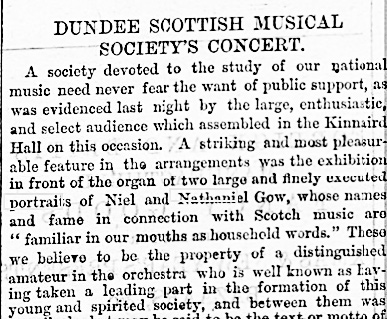
I now know, as explored in previous tweets, is that there was a least one oil painting of Nathaniel Gow that was gifted to the Birnam Institute in 1929. There was also a painting, perhaps the same one, by John Syme that is said to have been untraced since 1837. A painting was also mentioned as being on display in Dundee at a musical event in 1872. What we do have is a lithograph, or a reproduction of a lithograph, that may or may not have been based upon the painting by Syme.
Meanwhile, the Oxford Dictionary of National Biography has the drawing above, attributed to John Kay (1742-1826), as a likeness of Nathaniel. What do you think? Kay and Gow were certainly have been around Edinburgh at the same time and I like to imagine that Kay, as a barber, might have prepared his tie wig on occasion, hence the attention to that detail in the drawing.
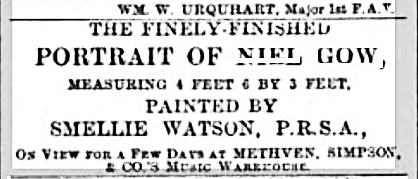
William Smellie Watson (1796-1874) was a decent portraitist based in Edinburgh and I suspect he would not have wished to copy the famous work by Raeburn, who had been a rival of his father George Watson (1767-1837). I have found no listing of this portrait.
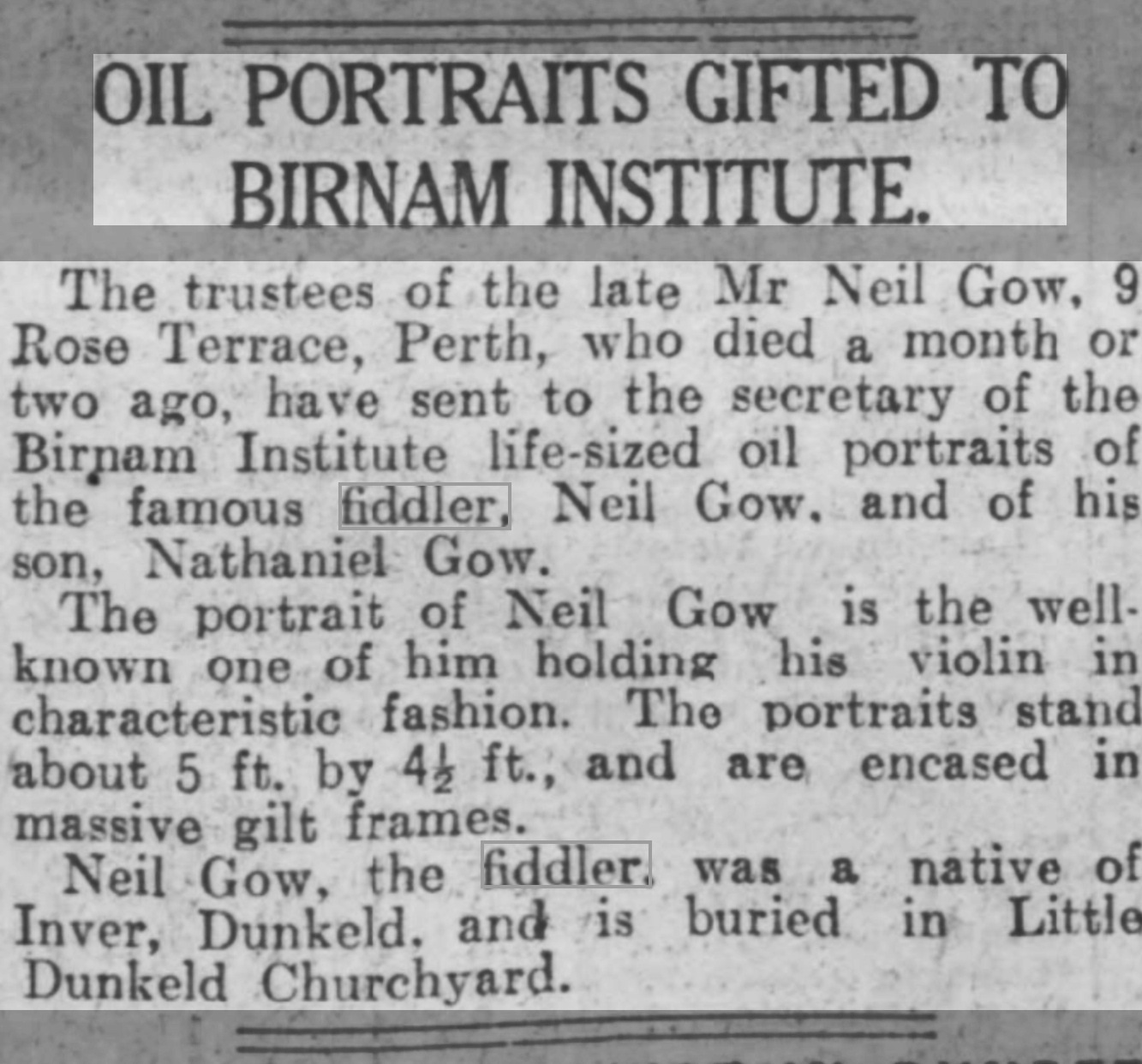
And what of this pair of portraits, father and son?:
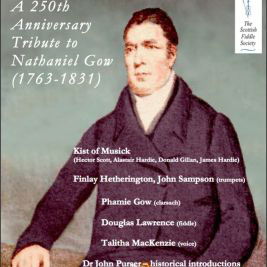
I was intrigued by this portrait used to advertise the recent 250th Anniversary Tribute to Nathaniel Gow (1763 – 1831) held in Edinburgh. Unfortunately I was unable to attend and I have not got round to asking anyone who should know but I wonder where the image came from and where the original resides. I had forgotten about it until I came across the following news report from The Dundee Evening Telegraph, 26 September 1929 (10):
Now, unless subject to some really serious Adobe Photoshop work, the image used to advertise the concert is, as they say in Glasgow “nae oil painting”. I looks to me like a coloured lithograph although that effect could occur if a poor photograph of an original image has been processed to make it reproducible.
The Oxford Dictionary of National Biography (Christopher D. S. Field, ‘Gow, Nathaniel (1763–1831)’, Oxford Dictionary of National Biography, Oxford University Press, 2004 [http://www.oxforddnb.com/view/article/11167, accessed 15 March 2015) quotes McGregor (J. McG. [J. McGregor], ‘Memoir of Nathaniel Gow’, in A collection of airs, reels and strathspeys, being the posthumous compositions of the late Niel Gow (1837), 4–7) who says that “a spirited likeness” of him was painted by John Syme. Is the image above ‘spirited’? It is noted that the painting, in oils, by Syme was “untraced since 1837” but there is also a reference to a “photolithograph, 1895, reproduced in Glen” which is, presumably, J. Glen, ‘Nathaniel Gow’, The Glen collection of Scottish dance music, 2 (1895), x–xiv in the list of references. G. S Emmerson, Rantin’ Pipe and Trembin’ String. (London, 1971) and M. A. Alburger Scottish Fiddlers and their Music. (London, 1983) both include grayscale images similar to that above. I have not examined Glen but it might carry an artist, or lithographer’s name.
So, it looks like the original oil painting is lost (let me know if I am wrong here) but that it might have still been around in the late 1920s. And what of the Niel Gow? Could that be the painting in the collection of Perth and Kinross Council?
Of further interest is the reproduction in the Dictionary of National Biography of youthful drawing of Nathaniel playing fiddle by John Kay said to be from the National Portrait Gallery (i.e. London, I presume). That’s a wholly new one to me and a real cracker.
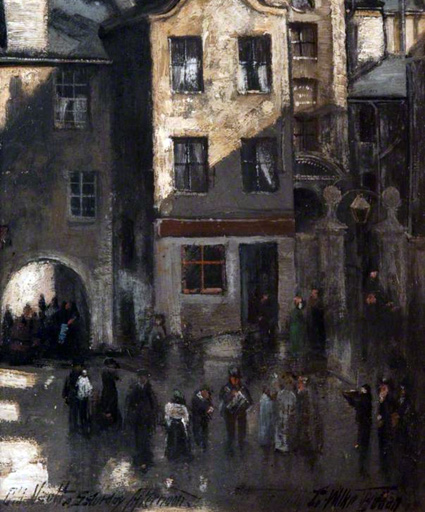
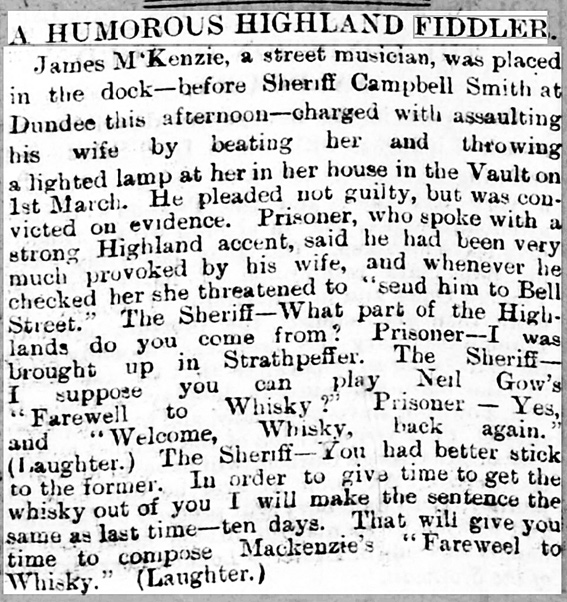
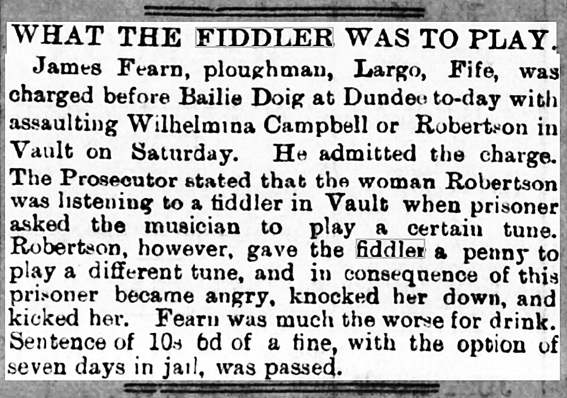
Many years ago, while researching the free-reed instruments in Scotland, I stumbled upon a number of references from the early twentieth century to criminal activity (theft, drunkenness, breach of the peace etc.) involving the accordion and was struck by the large number of cases in and around Dundee. Why Dundee? It would appear that the accordion was not the only musical instrument implicated in such activity and that fiddlers were, and associated with, an unsavoury lot:
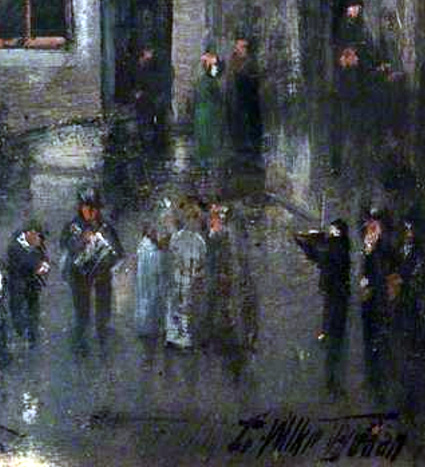
Vault was an old part of the town that had attracted the eye of many artists and photographers before it was redeveloped. In the painting of the site reproduced above and below I was delighted to find both a melodeon and a fiddle player:
More posts will follow on violin crime and on fiddlers in Scottish art in due course.
This well made outsider view of Scottish tradition for Web TV is well worth a look. Fiddler Sarah Hoy makes an appearance about 15 minutes in. A few other familiar faces in there too.
The National Trust for Scotland recently found some printing plates for a keyboard setting of the popular Scottish tune Kinloch of Kinloch in one of its historic properties. Research is ongoing into the music they contain. I had a quick look for other piano settings and found this lovely title page from the Levy Sheet Music Collection at the Milton S. Eisenhower Library of The Johns Hopkins University. This is a very interesting collection beautifully presented online. Focused on on popular American music spanning the period 1780 to 1960 there are many pieces of Scottish origin which can be located via the search facility. Others have illustrated covers and I am particularly taken by the cover of this publication from Philadelphia:
Pleyel (arranger); Kozeluch (composer); Haydn (composer); R. Burns (lyricist); Robert Burns (lyricist)(G.E. Blake, No.13 South 5th Street, n.d.]). http://jhir.library.jhu.edu/handle/1774.2/5453
I love the symbolism where the chanter of old John Anderson’s deflated bagpipe hangs limply down from the shelf on which the instrument is kept.
We use cookies to ensure that we give you the best experience on our website. If you continue to use this site we will assume that you are happy with it.